
Sportswear Design Mistakes to Avoid
- Greg Costaras
- Clothing
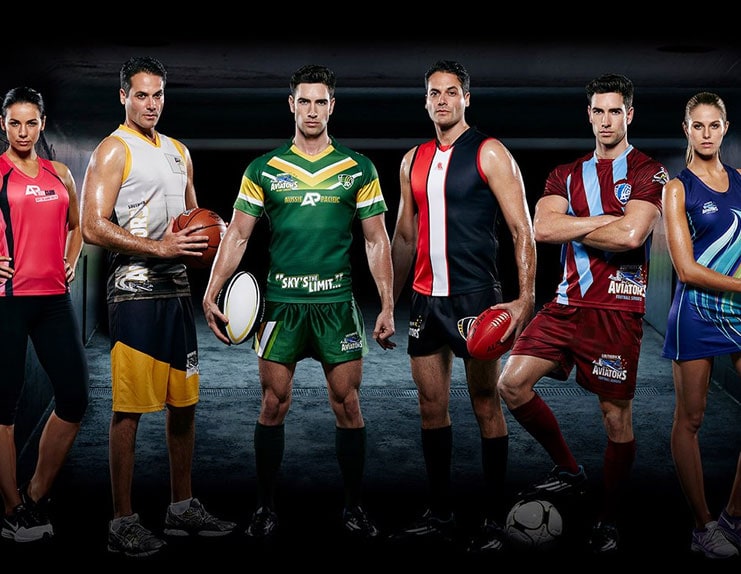
Designing custom sports uniforms for your club involves many moving parts: colours, fabrics, print methods, deadlines, and a team full of opinions.
Most jersey design mistakes happen before a single garment goes to print, and they’re rarely obvious until the order arrives.
This guide covers the most common sportswear design mistakes to avoid, as well as design tips, so your custom sports uniforms look great, perform on the field, and hold up all season long.
Need help designing custom sportswear? Gorilla Print has an in-house graphic design team ready to bring your kit to life. Get in touch today.
Sportswear Design Mistakes to Avoid — in summary
- Most jersey design mistakes happen before a single garment goes to print
- Darker, saturated colours hold better across print methods and wash cycles; supplying existing brand colours as PMS codes helps ensure accuracy, and dye sublimation locks colour directly into the fabric for significantly better fade resistance
- Names and numbers are what make a uniform feel like a kit
- The print method is as important as the design itself
- Always review the proof before approving production
- Custom sportswear requires a minimum of three to four weeks from final artwork approval to delivery
Where Most Custom Teamwear Orders Go Wrong
Custom teamwear is one of the most visible investments a club or organisation can make. The design needs to be memorable, functional, and something your players are actually proud to pull on, because a kit nobody wants to wear is money no one wants to spend.
These are the most common sportswear design mistakes to avoid before you go to print.
Choosing Colours That Clash or Fade Fast
Colour is the first thing anyone notices about a uniform, and one of the easiest things to get wrong. Digital displays use RGB colour while printed garments use CMYK or PMS, meaning what looks sharp on your monitor can print muddy or dull on a jersey. Before you lock in your colours, consider:
- Darker, saturated colours hold better across print methods and wash cycles
- Always supply existing brand colours as PMS codes for accuracy
- Dye sublimation locks colour directly into the fabric, making it significantly more fade-resistant than surface printing methods
Overcomplicating the Design
Less is almost always more. The best sports uniforms in the world share one trait: they’re instantly recognisable from a distance. Strong colours, clean lines, and a logo that reads clearly at speed. If someone needs to squint to make out your design, it’s too complicated.
Ignoring Fabric Performance
A great-looking jersey that performs poorly on the field is a waste of money. Different sports demand different properties: moisture-wicking, breathability, stretch and recovery, and durability for contact sports.
Get the fabric wrong, and your players will know about it within the first five minutes of the first game.
Forgetting to Personalise
Names and numbers aren’t just a finishing touch; they’re what make a uniform feel like a kit. Players who wear their name on their back feel a connection to the jersey that generic teamwear simply can’t deliver.
Not Thinking About the Print Method
Most people focus entirely on the design and forget to ask how it’s going to be printed. The print method affects colour accuracy, durability, and what’s actually possible in the design.
For full-colour, all-over custom sportswear, dye sublimation is the clear choice; the ink bonds directly into the fabric fibres, so the design won’t crack, peel, or fade after a full season of wear.
Skipping the Proof
Always review the proof before approving production. A proof lets you check colours, placement, sizing, spelling, and numbers before anything goes to print. Errors that take seconds to fix at the proof stage can mean reprinting an entire order at full cost if they’re missed.
Leaving it too Late
This is the mistake that catches clubs out every season. Custom sportswear takes time, design, approval, production, and delivery; all need to be factored in.
Allow a minimum of three to four weeks from final artwork approval to delivery, more if your order is large or highly customised. The clubs that look best on game day are the ones that planned ahead.
Trusted Custom Teamwear Tips
The best-looking teams on the field have a lot in common. Here, we’ve detailed some of the best sportswear design tips so that you can print uniforms to match.
1. Start With Your Team’s Identity
Before you touch a colour palette or pick a font, get clear on what your team stands for. Are you bold and physical, or fast and technical? Your uniform should reflect that.
Colours, logo placement, and design style should all connect back to your club’s identity, not just what looks good on a screen.
2. Keep it Simple and Bold
The designs that stand the test of time are clean, confident, and readable at pace. Resist the urge to add gradients, multiple fonts, or too many colours. Pick two or three colours maximum, lead with your strongest design element, and let it breathe.
3. Involve Your Players in the Design
The people wearing the kit should have a say in it. Even a quick poll on colours or logo placement creates buy-in and means fewer complaints when the order arrives.
4. Consider How the Design Works Across Sizes
A design that looks great on a size medium can shift, distort, or lose impact on a size XS or 2XL. Make sure logo placement and pattern elements are checked across the full size range before you approve.
Get Your Custom Sportswear Sorted
At Gorilla Print, we don’t just print your design; we help you build it. Our in-house graphic design team works with clubs, schools, and organisations across Australia to create custom sportswear that looks sharp and performs on the field.
From logo design and colour matching to full uniform concepts, we handle the creative side so you don’t have to. We produce custom sportswear for AFL, soccer, basketball, rugby, and more, using dye-sublimation printing for vibrant, all-over colour.

Greg Costaras
With over 25 years in print design and production, Greg is a specialist in the field, helping thousands of clients achieve their print dreams over that period.
Share This Post
More Posts
What Is the Difference Between Day and Night Hi-vis?
September 22, 2026

Embroidered vs Printed Polo Shirts
September 15, 2026
Basketball, Soccer or Rugby: Choosing the Right Uniform Style
September 8, 2026
What Makes Good Quality Workwear?
September 1, 2026